DevOps

We bring dev and ops together for real — not a team called DevOps, but a way of working where the same people build and run. Measurably better incident response, shorter lead time.

DevOps

DevOps is not about creating a team called ”DevOps”. It's about changing how engineering organisations work: the same people who build the system are also involved in running, monitoring and improving it in production.

When development and operations are separated, the usual results are long lead times, unclear ownership and slower incident response. With a modern DevOps way of working, the chain of responsibility gets shorter, feedback faster and quality more measurable.

What DevOps means in practice

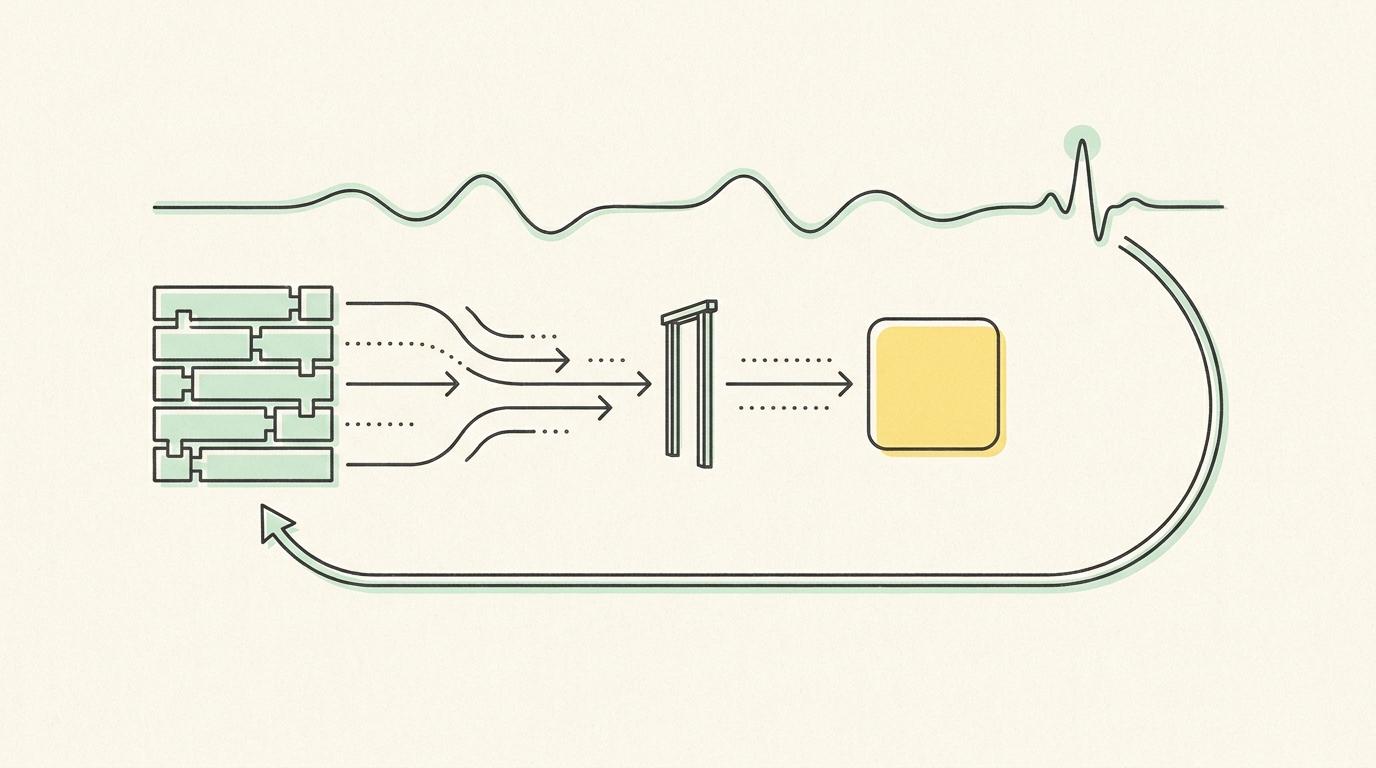
A working DevOps practice is built on teams owning the whole lifecycle:

  1. Build services and features.
  2. Deploy them in a safe, repeatable way.
  3. Monitor behaviour, performance and user experience.
  4. Handle incidents when something goes wrong.
  5. Learn from production and improve the system continuously.

What matters is not the tools themselves, but that the organisation shortens the distance between code, operations and user experience.

SRE and on-call: ownership where the system lives

Site Reliability Engineering, or SRE, is a way of making operations more systematic and measurable. Instead of a separate ops function ”taking over” after development, the team actively works with reliability, alerting, error budgets and automation.

A good on-call setup means more than someone carrying a pager. It means the team has:

  • Clear alerts that can be acted on.
  • Runbooks for recurring problems.
  • Metrics that show real user impact.
  • A mandate to improve the system after incidents.

When the people who write the code also get feedback from production, technical ownership grows stronger.

IaC and GitOps: infrastructure as code

With Infrastructure as Code, environments, networks, policies and resources are defined in code. That makes infrastructure more traceable, testable and repeatable.

GitOps takes this further by using Git as the source of truth. Changes are reviewed, versioned and rolled out in a controlled way.

The benefits are clear:

  • Less manual work and fewer configuration errors.
  • Faster recovery when something breaks.
  • Better traceability of who changed what, and why.
  • More predictable releases across environments.

Teams can move faster without losing control.

Incidents and post-mortems: learning without blame

Incidents will happen. The difference between a mature and an immature organisation is in how it responds.

A strong DevOps culture treats incidents as learning opportunities. After an incident, the team should run a blameless post-mortem focused on systems, processes and decisions — not on finding a scapegoat.

A good post-mortem answers questions like:

  • What happened?
  • How was the problem detected?
  • How were users affected?
  • What worked well in the response?
  • What needs to improve?
  • Which concrete actions will be taken?

The goal is for every incident to make the organisation more robust.

AIOps and autonomous agents: the next step in operations

AIOps uses AI and machine learning to analyse logs, metrics, traces and incident data. It helps teams find anomalies faster, prioritise alerts and suggest actions.

The next step is autonomous agents that not only detect problems, but can help troubleshoot, write summaries, propose pull requests or automate parts of the incident response.

That doesn't mean humans disappear from the process. On the contrary, human judgement becomes even more important. Used well, AIOps reduces noise, shortens troubleshooting and frees up time for more valuable work.

Measurable effects of DevOps

When DevOps works, it shows in concrete results:

  • Shorter lead time from idea to production.
  • Faster incident response and lower MTTR.
  • Fewer manual errors through automation.
  • Higher availability and better user experience.
  • Stronger ownership in the teams.

DevOps is not an org chart. It's a way of working where technology, ownership and learning come together.

Conclusion

Real DevOps means development and operations are not treated as two separate worlds. Teams build, run and improve their systems with the same sense of ownership through the whole lifecycle.

With SRE, on-call, IaC, GitOps, incident management, post-mortems, AIOps and autonomous agents, organisations can build technical platforms that are faster, more stable and better at learning.

That's where DevOps delivers real impact: shorter lead times, better incident response and systems that evolve through experience from real operations.

01 / 04

Discover

We learn the business, map stakeholders and identify where the real value actually lives.

02 / 04

Define

Concrete scope, decision points and a plan you can take to the board.

03 / 04

Build

Short sprints, continuous demo, incremental release. No 6-month waterfalls.

04 / 04

Operate

We help hand it back to your team, or stay on as a managed-operations partner.

Got a problem worth solving?

Contact us